In the early years of my career, success was easy to define.
Ship the feature.
Ship it on time.
Ship it clean.
Coming from a deep technical background, I was obsessed with execution. Writing good code, closing tickets, meeting sprint commitments—those were the metrics that mattered. If you had asked me five years ago what I was working on, I probably wouldn’t have had a meaningful answer. It didn’t matter. What mattered was that the code worked and went live.
I was talking to my scrum master, my lead engineer, and a small circle of developers. The end user was a distant concept—somewhere beyond the backlog, outside my immediate responsibility.
That mindset helped me become a strong engineer. But it also blinded me to something far more important: products are not judged by what they ship, but by what they enable.
The Advice I Didn’t Fully Understand
As I grew into a Lead Engineer role, my CTO would often repeat a line that felt vague at the time:
“Think from the user’s standpoint.”
I agreed with it in principle, but in practice, I didn’t truly get it. The requirements were already defined. The roadmap was locked. The feature was approved. What exactly was left to think about?
In hindsight, I was confusing delivery with value.
It wasn’t until I started joining customer conversations—beyond demos and sprint reviews—that the gap became impossible to ignore.
When Client Conversations Changed My Perspective
It was only when I started joining client conversations that the shift became real. I noticed that stakeholders rarely talked about features. Instead, they spoke about outcomes — what they needed to achieve, the problems they were solving, and how they were approaching solutions in their own context.
That’s when I began to see the bigger picture: delivering a feature is one thing, but enabling a capability is another. Slowly, almost imperceptibly, my thinking started to shift—from counting features shipped to understanding the capabilities those features unlocked for users.
Features vs Capabilities: A Simple but Powerful Distinction
Once I started seeing how stakeholders approached problems, the difference became clear.
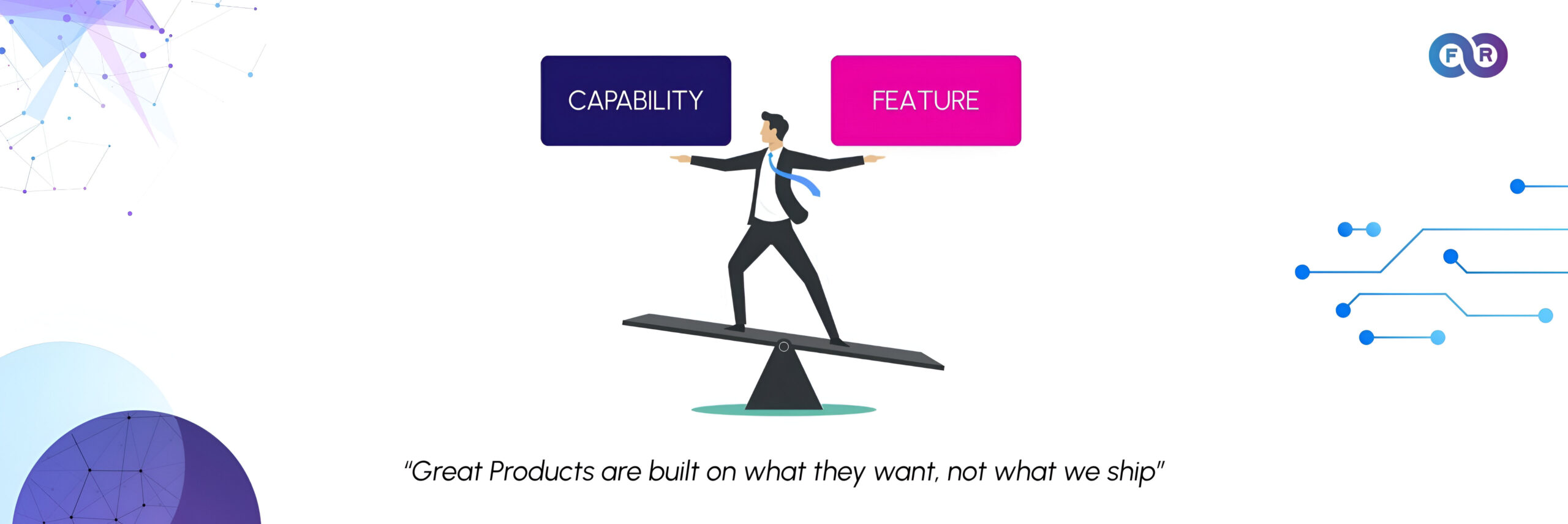
A feature answers the question: “What did we build?”
A capability answers: “What can the user now achieve?”
Features are internal milestones, checkpoints for the team. Capabilities are the external value—the real impact on the user’s work. Users don’t buy dashboards, filters, or connectors—they buy the ability to understand, decide, act, and improve.
This distinction matters because a product can ship hundreds of features each quarter, but adoption will still lag if those features don’t translate into usable capabilities.
The Moments That Changed How We Think About Capabilities
The shift from feature-led thinking to capability-led thinking didn’t happen overnight. It happened through a couple of very specific moments that forced us to look beyond what the product could do and focus on how quickly and effectively customers could use it.
Incident 1: When Insight Was Right—but Too Late
We were once deep into a deal with a client who was already evaluating multiple process intelligence platforms. They liked FUTUROOT’s UI, the depth of features, and the overall approach. On paper, we were at par—if not ahead—especially given the combined ERP and consulting experience behind the product.
Yet, we lost the deal late in the cycle.
The reason had nothing to do with missing functionality.
What we didn’t have at the time were accelerators that could get them insight-ready quickly. The client would have needed an additional two to three weeks of setup before meaningful insights could be generated.
That delay mattered.
It forced an uncomfortable realization:
insights are only valuable if they arrive when decisions are being made.
This was the moment we understood that capability isn’t just about what the product delivers—it’s also about how fast it delivers it. That realization led directly to building scenario-based, pre-built packages designed to make customers insight-ready from day zero, right after data loads.
Incident 2: When Assessment Wasn’t Enough
FUTUROOT, backed by Percipere, brings over 500 years of combined ERP transformation and consulting experience. While using FUTUROOT to assess SAP ECC systems for landscape transformation, we started noticing a recurring pattern.
Customers valued the analysis—but they struggled with what came next.
The assessment clearly showed what needed to change. But execution still demanded significant manual effort, coordination, and time. That gap slowed down transformation programs and exhausted teams.
So we pushed capability thinking a step further.
The goal wasn’t to add another feature.
It was to remove friction at the most painful stage of transformation—turning insight into execution—by reducing preparation effort and accelerating progress.
Why Feature-Led Thinking Can Stall Products
Adding more features doesn’t automatically translate to better outcomes. Adoption often fails not because products lack functionality, but because complexity prevents users from realizing the value.
Some common symptoms of feature-heavy products include:
- Overloaded interfaces
- Endless configuration options with unclear payoff
- Steep learning curves
- Heavy reliance on specialists or consultants
Without a capability-first approach, products become toolkits for experts rather than enablers for teams. In process intelligence and enterprise workflows, this is especially risky: if understanding the system becomes harder than doing the work, adoption stalls—and value remains locked away.
Capabilities Are Designed Around Outcomes
Capabilities are not just features with a fancier name—they are what the user can do with the product in practice. Strong capabilities share a few consistent traits:
- They Align With Real User Workflows
- Capabilities reflect how people actually operate, not how the system designers wish they did. In industries like manufacturing, retail, finance, and procurement, this means accounting for exceptions, variations, and real-world constraints..
- They Reduce Effort, Not Just Add Power
- The best capabilities simplify processes and make results intuitive. Complexity remains under the hood.
- They Scale Across Experience Levels
- A first-time user should get value quickly. An experienced user should be able to go deeper without requiring a different product.
- They Deliver Impact Even When Used Lightly
- A well-designed capability should provide measurable benefit even if a user engages with only part of the functionality.
- A well-designed capability should provide measurable benefit even if a user engages with only part of the functionality.
These are features carefully curated to enable users with the right capabilities—to improve ROI, give them control over their processes, make insights actionable, and help teams continuously drive better outcomes.
One of our clients, the CFO of a renewable energy company in the UK, recently said, “We do not need another dashboard, but to precisely understand why our POs are stuck and what we can do about it. Your tool gave us that in the first week, without needing a consultant to figure it out.” It validates what we have learned: users value the ability to act, not just the ability to see.
The Shift Every Product Manager Must Make
Moving from a feature-first to a capability-first mindset is about asking the right questions:
- What decision does this help the user make?
- What friction does this remove from their workflow?
- How does this change the user’s day?
- Are we simplifying—or adding another layer?
This is where product, design, and engineering must work as one. Not to ship more—but to enable better outcomes.
Product management taught me how to listen.
Today, when I review a roadmap, I don’t count features. I look for strengthened capabilities. If a feature doesn’t clearly improve what users can do, it doesn’t belong—no matter how elegant the implementation. That shift in thinking changed the way I build products—and the impact they create.
Capabilities We’re Building at FUTUROOT
If capabilities are about enabling outcomes, here’s how FUTUROOT is putting that philosophy into practice, with tangible examples:
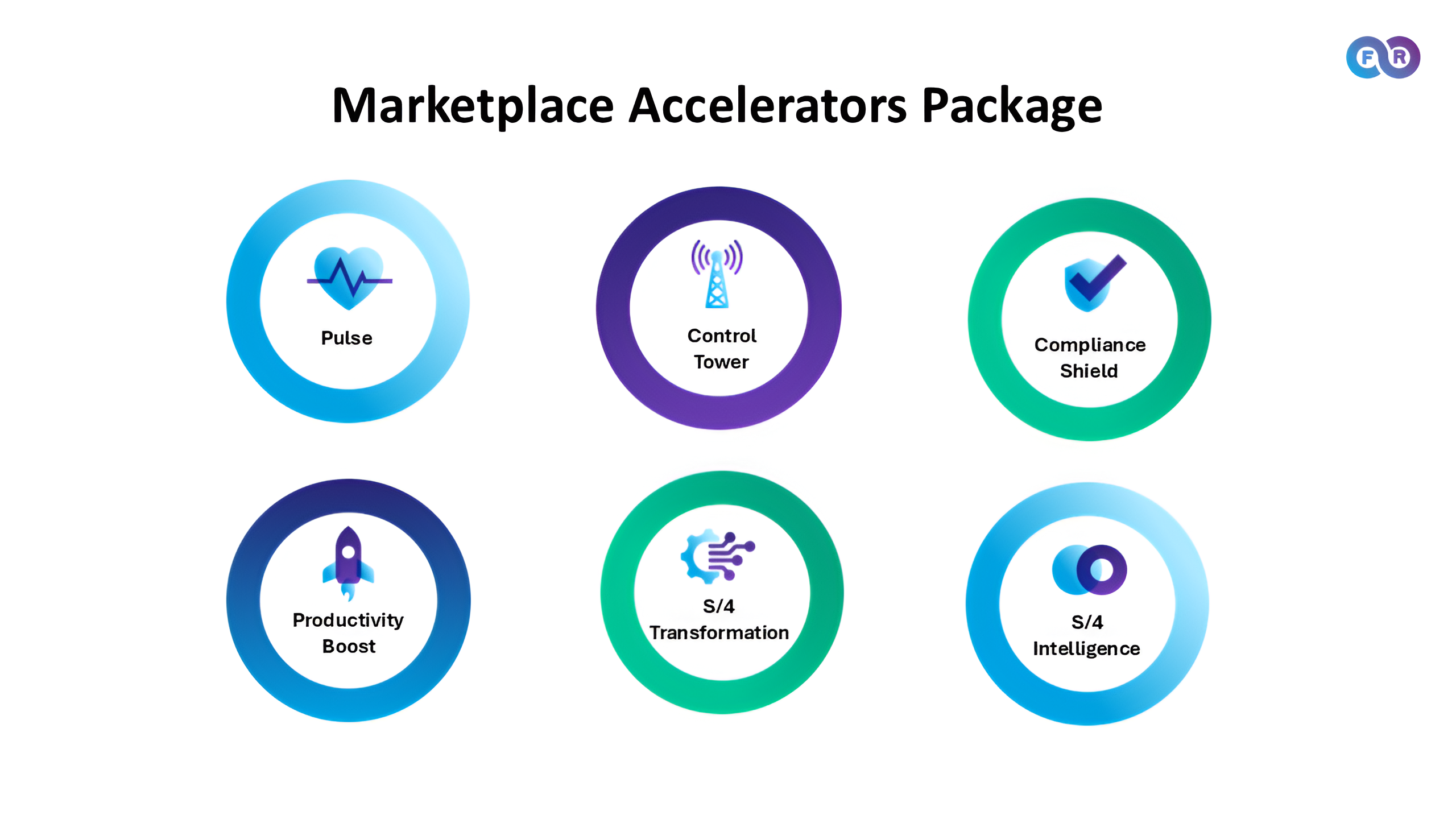
- Marketplace Accelerator Packages: Install and Go
- Teams can seamlessly connect to their ERP systems and kickstart their Process Intelligence journey using FUTUROOT’s Marketplace Accelerator Packages. These pre-built, S/4-ready packages are designed to minimize setup and configuration effort, allowing users to start realizing value almost immediately.
- The accelerator packages deliver instant process visibility and system health insights, support audit and compliance readiness across industries, and provide a centralized control view to track adoption and improvement progress over monthly and quarterly intervals. By packaging proven capabilities together, they remove friction from onboarding and help teams move faster from insight to sustained impact—without heavy customization or long lead times.
- Enhanced User Experience
- Interfaces are designed to minimize friction and surface insights clearly, helping finance, procurement, manufacturing, and retail teams navigate complex processes without heavy training.
- Co-Pilots with Tuned MCP Models
- Co-pilots are tuned for specific processes, guiding users through workflows, highlighting exceptions, and suggesting next best actions to improve outcomes.
- Predictive Analytics for Enterprise Workflows
- From identifying bottlenecks in procurement to predicting exceptions in order-to-cash, these capabilities help teams act proactively rather than reactively.
These are features carefully curated to enable users with the right capabilities—to improve ROI, give them control over their processes, make insights actionable, and help teams continuously drive better outcomes.
My Personal Reflection
In process-driven organizations, complexity already exists. Software shouldn’t add to it—it should help manage it. By focusing on capabilities rather than outputs, products become easier to adopt, insights become actionable, and improvement becomes a natural part of the workflow.
Features are important, but they are not the measure of impact. Capabilities are. When we build products that truly strengthen what users can do, the results are meaningful, lasting, and genuinely useful.
 Related Blogs