Archives: Case Studies

  • From Migration Assessment to Strategic Capital Allocation

    From Migration Assessment to Strategic Capital Allocation

    • Client: A leading European HVAC manufacturer
    • Industry: HVAC Manufacturing
    • Region: France/Europe
    • Partner: Gauri Ltd

    Exec Summary

    For three decades, enterprise transformation followed a predictable pattern: Big 4 firms owned assessment, partners executed delivery, and intelligence was sold as labour. FUTUROOT helped Gauri Ltd, to shift that, delivering in 8 weeks what the likes of IBM typically take 12–16 – more precise, and with immediate operational gains.

    The client faced a €multi-million SAP S/4HANA migration decision with a critical constraint: greenfield implementation was prohibitively expensive, while brownfield risked carrying forward 25 years of technical debt. Using FUTUROOT, Gauri delivered forensic clarity in 8 weeks that enabled the client to pursue a hybrid strategy – brownfield where viable, targeted greenfield where essential. The data revealed 90% of custom objects had never executed, over half of sales order types were obsolete, and Classic GL optimization opportunities that could deliver immediate value and secured two immediate follow-on projects for Gauri. The assessment prevented millions of euros of misallocated migration spend by eliminating inactive scope before a single line of SAP S/4HANA code was touched.

    At a Glance: What Changed Because of This Assessment

    • 8 weeks: Assessment delivery vs 12-16 weeks Big 4 standard
    • 2,000+ custom objects: 90% identified as inactive through execution log analysis → Prevented unnecessary remediation of 1,800 objects
    • 12 → 5 sales order types: 7 legacy types eliminated, 95% of revenue flows through 5
    • 2 immediate projects: Data cleansing + Unicode conversion secured
    • Classic GL migration opportunity identified for the interim


    The Challenge

    The client’s SAP ECC was 25-year-old. Leadership knew SAP S/4HANA migration was inevitable but faced a strategic dilemma: greenfield would be prohibitively expensive, while brownfield risked carrying forward inefficiencies and technical debt – both irreversible once migration began. The decision hinged on understanding what actually existed – which custom code was needed, which processes required redesign, what could be retired.

    Traditional Big 4 assessments deliver maturity ratings over 3-4 months with potentially generic rankings following traditional assessment methodology. Without forensic clarity, the client couldn’t determine if brownfield was viable or selective greenfield necessary.

    Gauri, as implementing partner, faced a familiar constraint: in the traditional model, assessments are loss-leaders priced to win implementation, rewarding complexity over clarity. They set out to invert it – selling intelligence, not hours; generating pre-implementation revenue while strengthening their strategic advisory position.

    Both organizations needed objective truth before committing millions to migration.

    The FUTUROOT Solution 

    FUTUROOT analyzed 100% of the client’s transaction data over 24 months, across Finance, Procure-to-Pay, and Order-to-Cash areas. Multiple discoveries reshaped both the migration approach and revealed immediate optimization opportunities:

    Custom Code Analysis

    • 2,000+ custom objects analyzed through 12-month execution logs
    • Finding: 90% had never executed
    • Outcome: Migration scope reduced to ~200 active objects requiring Unicode compliance
    • Immediate value: the client could begin decommissioning unused programs in current ECC, reducing system complexity before migration
    • Net effect: migration effort reduced by an order of magnitude before scoping began
    Sales Order Rationalization
    • 12 configured sales order types analyzed by transaction volume
    • Finding: 95% of revenue flowed through 5 types; 7 were legacy from acquisition
    • Outcome: 58% reduction in O2C migration scope
    • Immediate value: Opportunity to simplify current-state processes, improving order entry efficiency
    • Net effect: simpler operations today and materially lower test, conversion, and regression risk during migration.

    Process Variation Analysis: Procure-to-pay Variations Discover
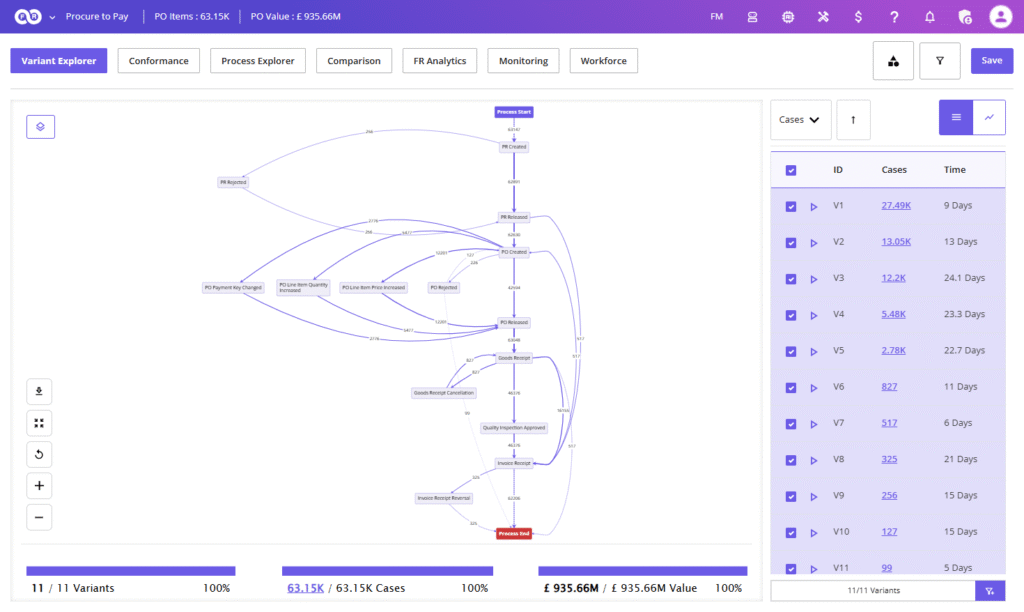
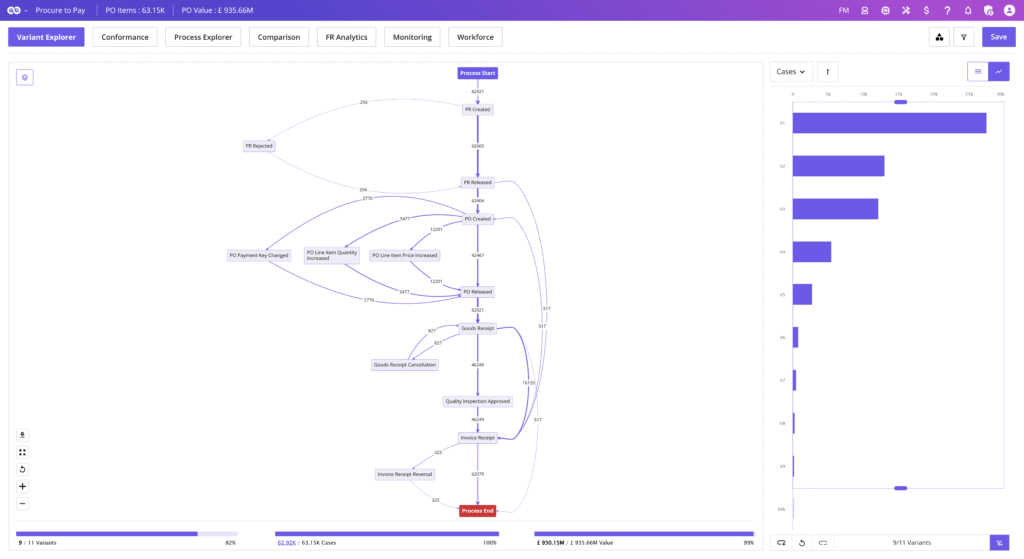
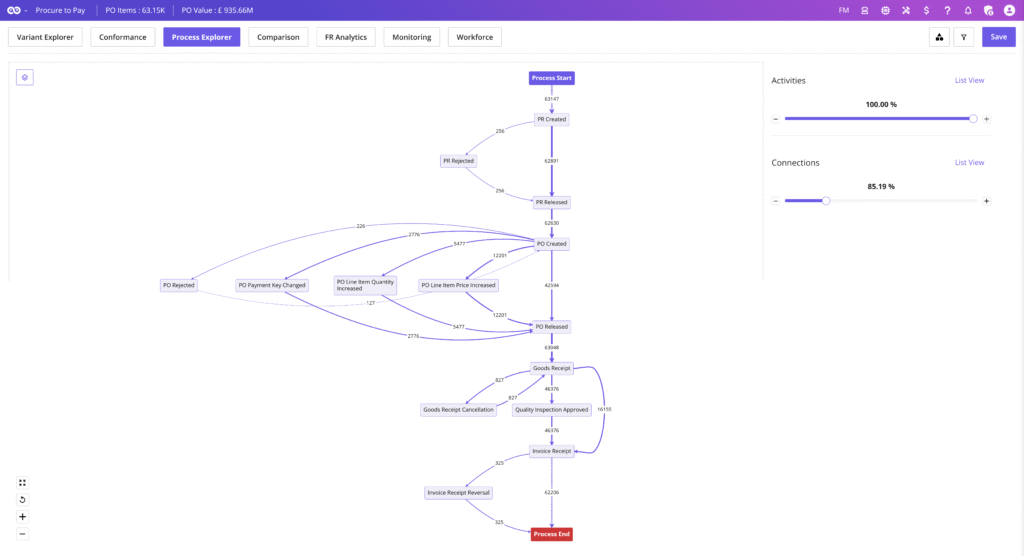
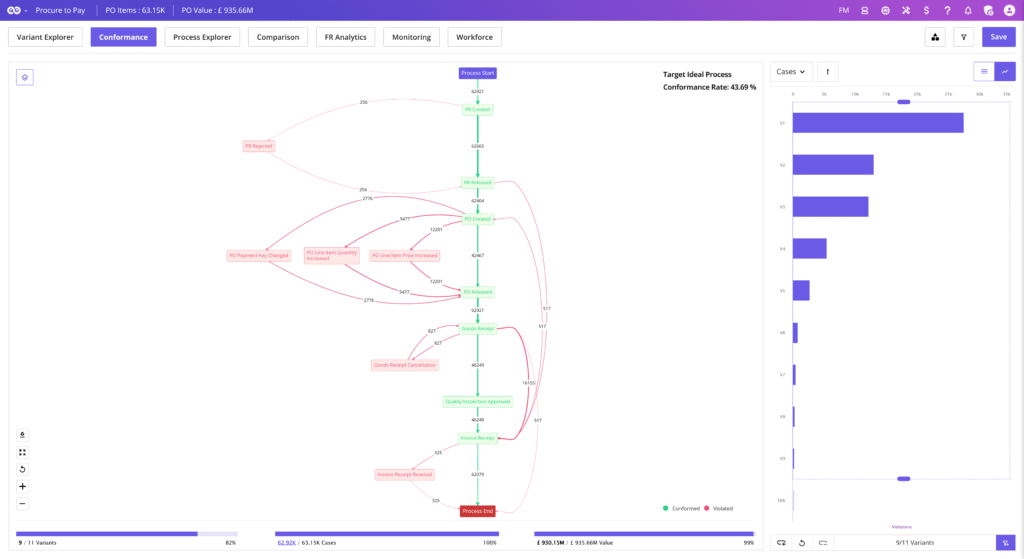
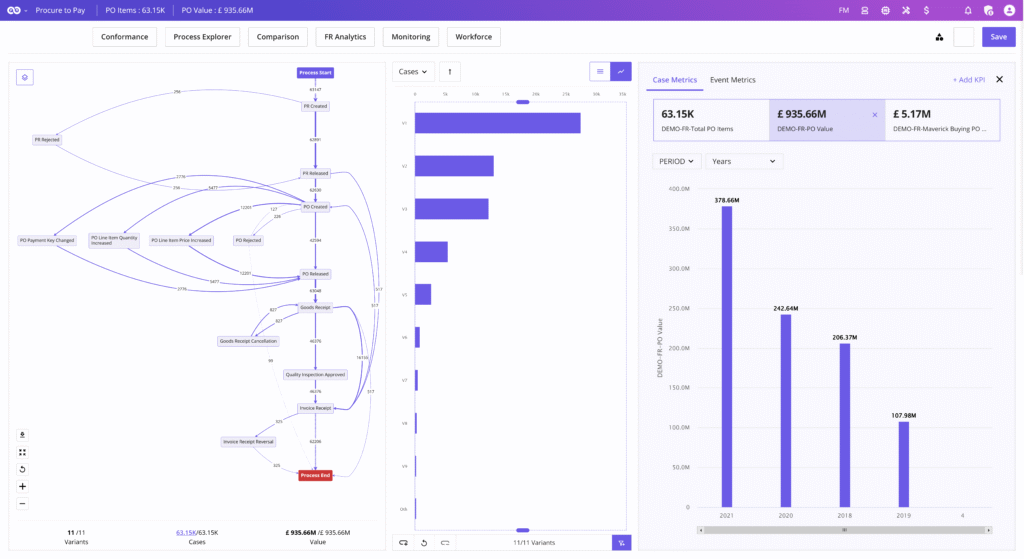
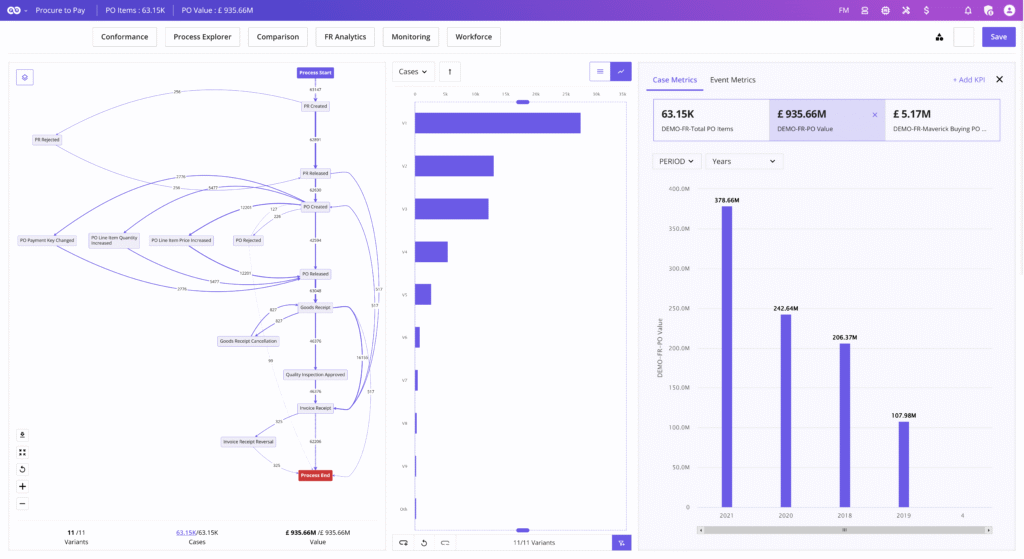
    • Procure-to-Pay process maps revealed significant variation in purchasing flows, with a material proportion of cases terminating at the Purchase Requisition stage instead of progressing through the ideal PR → PO → Goods Receipt → Invoice path.
    • Finding: This pointed to breakdowns in approval flows, potential sourcing delays, duplicate or abandoned requisitions, and potential maverick buying behaviour.
    • Value: A considerable eye opener for the business, this was identified as a strong candidate for pre-implementation remediation as well as a post-migration continuous improvement opportunity.
    Classic GL Optimization Opportunity
    • Technical analysis flagged the client was still operating Classic General Ledger (not New GL)
    • Finding: Recommendation: Implement New GL (offering parallel accounting, ledger flexibility, faster financial closing) in current ECC before SAP S/4HANA migration
    • Immediate value: Estimated 20-40% faster financial closing through improved FI-CO reconciliation, while de-risking eventual SAP S/4HANA conversion (avoiding double transformation: Classic → New GL → Universal Journal)
    • Net effect: avoided double transformation and unlocked value before SAP S/4HANA.
    Master Data Quality Issues
    • Analysis revealed multiple legacy company codes with minimal usage (<100 transactions), duplicate customer/vendor records, material master inconsistencies
    • Finding: SAP S/4HANA’s Business Partner model requires customer-vendor deduplication before migration
    • Recommendation: Data cleansing with 66% reduction potential (proven at comparable Agro industry client)
    • Immediate value: Pre-implementation revenue opportunity for Gauri; better reporting accuracy for the client
    Warehouse Management Incompatibility (Identified through broader assessment)
    • Assessment workshops and technical analysis identified WM solution allowed negative stock in physical bins
    • Finding: Negative stock (inventory below zero) is forbidden in SAP S/4HANA kernel architecture
    • Outcome: Brownfield WM migration proved technically impossible; greenfield EWM required

    Business Impact

    For The Client

    Traditional brownfield would have meant remediating all 2,000 custom objects, migrating 12 sales order types, and attempting WM conversion. FUTUROOT and the comprehensive assessment enabled selective strategy:

    • Finance, P2P, O2C: Brownfield migration (minimal changes)
    • Warehouse Management: Greenfield EWM (technical incompatibility identified)
    • Custom code: Focus on 200 active objects only
    • Order types: Eliminate 7 obsolete configurations
    Immediate operational improvements identified:
    • Classic GL migration delivering 20-40% faster financial closing before SAP S/4HANA work begins
    • Process variation corrections addressing lost revenue
    • Master data cleansing improving current reporting accuracy
    • Order type rationalization simplifying current operations

    Capital redirected from remediating 1,800 inactive objects funded strategic EWM implementation. The client achieved hybrid approach: brownfield where technically viable, targeted greenfield where essential, zero investment in obsolete functionality.

    For Gauri: Partner Ecosystem Validation

    The assessment strengthened Gauri’s position as trusted advisor, creating immediate revenue while establishing foundation for long-term implementation partnership.

    Three Structural Advantages:

    FUTUROOT’s platform delivered capabilities that differentiated Gauri’s engagement from traditional approaches:

    • Unified (ERP + Process Mining) expertise & FUTUROOT’s ERP Native Experience:  When Gauri engaged FUTUROOT, they received a team comprising both process mining experts and ERP specialists deeply familiar with SAP S/4HANA migrations. This eliminated the 1.5-2 month delay typical when Big 4 firms deploy separate BPM and ERP teams requiring methodology alignment. SAP-native connectors and pre-built P2P/O2C templates enabled immediate deployment without specialist onboarding.
    • Flexible economics enabling competitive pricing: FUTUROOT’s subscription model gave Gauri pricing flexibility unavailable to competitors whose economics require billing hours. Whether analyzing 2,000 or 20,000 custom objects, Gauri’s cost remained fixed – enabling competitive client pricing while maintaining margins. This structural advantage proved decisive in winning the assessment engagement.
    • Enterprise-grade precision at mid-market economics: The client received analytical sophistication typically reserved for Big 4 engagements – execution log analysis identifying exactly 200 of 2,000 active objects, volume flows revealing 95% revenue concentration in 5 of 12 order types – at mid-market pricing. This precision positioned Gauri as first-mover for the eventual migration tender.

    This engagement demonstrates how mid-tier partners can compete with Big 4 firms on intelligence, without changing their delivery DNA.

    Engagement Outcomes:
    • Technical authority through data: 100% transaction coverage analyzing 2 years of production data provided irrefutable findings; Classic GL discovery revealed optimization opportunity the client didn’t know existed. Technical evidence drove decisions, not consultant opinions.
    • Fixed-price confidence through scope precision: Exactly 200 active objects requiring Unicode compliance – not “approximately 2,000 requiring review.” This specificity eliminated delivery risk and enabled accurate fixed-price proposals for follow-on work.
    • Channel-ready white-label deployment: Gauri operated FUTUROOT under their own brand, maintaining client relationship control while leveraging proven expertise. This model enabled mid-tier partners to compete on intelligence, not just cost.
    • Pre-implementation revenue generation: The assessment itself was revenue-generating (consultant savings of up to 2 FTEs), immediately creating expansion opportunities. Four optimization opportunities identified (data cleansing + Unicode conversion + Classic GL migration + process optimization), of which two projects commissioned (data cleansing + Unicode conversion). Each follow-up project strengthens Gauri’s position for the eventual migration tender, transforming assessment from loss-leader into profitable strategic entry point.
    Results:
    • 4 immediate optimization opportunities identified
    • 2 pre-implementation projects secured (data cleansing + Unicode conversion)
    • Prototyping timeline reduced from months to weeks (2,000 → 200 objects)
    • Long-term implementation partnership through 2027
    • Competitive advantage vs competitors

    Client Perspective

    “The day we saw the process maps, we were blown away. The variations and insights were invisible in our standard reporting – things buried in the tables that you would never see without analyzing 100% of transactions. When we discovered issues in our order-to-cash flow and learned we were still on Classic GL, those were current operational improvements we could pursue immediately. We had a data-driven hybrid strategy we could defend at board level, with both near-term wins and long-term migration clarity.”

    – IT Leadership, Client Company

    Partner Perspective

    “Percipere’s ERP heritage made the difference. They brought 500+ implementations worth of knowledge baked into FUTUROOT – SAP-native connectors, pre-built P2P and O2C templates, execution log analysis that’s invisible to generic process mining tools. When we engaged them, we got ERP experts who operate the platform, not separate BPM specialists requiring weeks to align with our SAP team. The assessment delivered decisions our client could act on immediately – exactly which 200 of 2,000 objects were active, opportunities like Classic GL migration they didn’t know existed. That precision gave us fixed-price confidence for follow-on work and positioned us as strategic advisors to the client.”

    – Anand Swamy, Co Founder, Gauri Ltd.

    About the Organizations

    The Client is a leading European HVAC manufacturer with 25+ years of SAP ECC operations and multi-site complexity across Finance, Supply Chain, and Manufacturing.

    Gauri Ltd is a UK-based SAP and CRM consultancy specializing in SAP S/4HANA transformations and Salesforce implementations for mid-market enterprises. Since 2023, Gauri has maintained a successful collaborative partnership with Percipere, resulting in multiple client deliverables across ERP assessment and implementation projects. This was the 2nd FUTUROOT engagement for Gauri after a successful engagement with a leading UK commercial lighting manufacturer.

    FUTUROOT is an enterprise process intelligence platform developed by Percipere, a SAP Gold Partner with 500+ ERP implementations globally. Purpose-built by ERP implementers with a mission to democratize process mining, the platform features SAP-native connectors and pre-built process templates that enable business users to operate it without data science teams. FUTUROOT is deployed direct-to-enterprise and through white-label partner channels.


  • FUTUROOT helps an Agro Business to move from Process Assessment to Intelligence Platform

    FUTUROOT helps an Agro Business to move from Process Assessment to Intelligence Platform

    • Client: Leading Agro Industry Company
    • Industry: Diversified Agro – Industrial (Animal Feed, Dairy, Poultry, Food Processing)
    • Region: India

    Exec Summary

    Our customer is a ₹5,000 crore agro-industrial company, where FUTUROOT was engaged alongside IBM during a primary high-level assessment for SAP transition – to work first on P2P processes to derisk complexities during actual SAP S/4HANA Migration. FUTUROOT’s data-driven approach revealed 15,409 process variants where leadership expected much lesser and is being expanded upon our client’s audit team requested 150+ additional KPIs.During implementation, FUTUROOT co-developed data extraction capabilities with SAP S/4HANA migration compatibility. This helped customer to reduce master data volume by 66%.

    The platform subscribed for a one-time assessment is being explored as an infrastructure for continuous monitoring and innovation.

    At a Glance


    The Pilot (FUTUROOT Pulse
    P2P)
    238,000 transactions (58,035 crore), 15,409 variants vs. much lesser numbers assumed, a 46-day bottleneck, resource concentration handling 53% of
    clearances, and circa 15% segregation-of-duties violations.
    The Extension (FUTUROOT – Data Intelligence)co-developed data remediation, improvement and migration capabilities (66% data reduction: 80,000 → 27,000 materials)
    The Expansion(FUTUROOT – Audit & Compliance Shield – Work in Progress)Audit team requested 150+ KPIs, Theme based Audit Reporting on P2P, O2C, Inventory
    Theme 1: PR / PO / GRN / Invoice Integrity Controls,
    Theme 2 : Vendor Master / Compliance / MSME Controls,
    Theme 3: Financial Integrity & Tax Compliance Controls
    Theme 4: Inventory, Quality & Consumption Controls
    Theme 5: Rate, Price & Trend Analytics
    Theme 6: Logistics, Incoterms & Freight Controls
    Theme 7: Internal Audit Behavioural Analysis (User-Based)
    The Evolution (FUTUROOT –
    Control Tower – Proposed)
    One-time assessment → continuous monitoring platform → operating system for
    process discipline and compliance -> Quarterly cycle of Insight Recommendation->Corrective Action ->Review-> Adapt -> Reiterate

    The Challenge

    Our customer, a ₹5,000+ crore agro-industrial company, was preparing for SAP S/4HANA migration. IBM’s traditional assessment delivered maturity scores but not specifics. Percipere, proposed a fact-driven analysis focused on P2P to start with.

    The Solution: 100% Transaction Intelligence in 6 Weeks 

    The Finding

    FUTUROOT extracted 238,000 P2P transactions from customer’s SAP ECC system, between April 2024 and March.The findings were materially different from traditional assessments.

    • Process Complexity: 15,409 distinct process variants identified where leadership assumed much lesser! The most common variant – 27% of cases, representing a fifth of the business averaged a 66.4-day cycle time.
    • Invoice Automation Opportunity: The 46-day invoice clearing cycle time reflected resource concentration in 53% of all clearances – pointing to optimization opportunities through automation or workload rebalancing
    • Supplier Performance: A 38.62% late delivery rate identified, with two specific mills accounting 14,000+ late deliveries.
    • Controls Strengthening Roadmap: 15% segregation-of-duties improvement opportunities were identified.The analysis provided visibility into specific business units (e.g., Poultry) requiring priority attention.

    “Traditional consulting provided only directional guidance. Our P2P is at maturity level 3 with automation opportunities. FUTUROOT provided precision: which of the 15,000+ variants to standardize, which supplier mills to address for late deliveries, and which business units to prioritize for control strengthening all traceable to specific transactions. It helped us concentrate on the areas where automation opportunities lie. – Cutomer’s Leardeship Team

    Business Impact: The Evolution from Pilot to Platform

    Phase 1: The Findings

    The precision of the P2P findings delivered actionable intelligence backed by transaction IDs. Our customer made a decision to extended FUTUROOT to O2C, Inventory, and Manufacturing, (currently ongoing) making it the intelligence layer for Phase 2.

    Phase 2: First Expansion (FUTUROOT- Compliance and Audit Shield)

    Our customer’s audit team identified value beyond standard process mining. They requested 50+ additional KPIs requiring integration of master data with process data – questions such as: “Show all price changes by User X on materials from Vendor Y in Plant Z.”

    Standard process mining focuses on event sequences. These audit requirements demanded cross-dimensional data relationships that most process mining tools cannot support.

    During the engagement, the technical team extended FUTUROOT’s capabilities to integrate master data with process data, enabling dimensional drill-downs typically unavailable in process mining platforms. This innovation was driven by audit needs and enabled by ERP domain expertise. FUTUROOT also developed an AI enabled
    feature that converses with the User to create KPIs drastically reducing dependency and empowering business to take control of future requirements.

    Audit adoption will establish the foundation for continuous operational monitoring.

    Phase 3: Second Expansion ( FUTUROOT – SAP S/4HANA Data Intelligence)

    SAP S/4HANA implementation introduced the data migration challenge common to every ERP transformation. Our cutomer faced more than a decade of SAP ECC data across 15 company codes consolidating into 6–7. SAP’s Excel-based migration approach would have required months of extraction, transformation and manual review for 80,000
    material records. Besides,

    • SAP S/4HANA pricing includes database size; every redundant record increases cost
    • Manual review delays go-live
    • Manual data entry introduces errors into the new system

    Our customer’s requirement was explicit: “We want a partner with a tool to clean the data before migration.”

    Percipere co-developed FUTUROOT’s data migration engine to:

    • Extract master data from SAP ECC
    • Apply automated rules to identify duplicates
    • Transform data for organisational remapping (15 codes → 6–7)
    • Generate SAP-compliant XML templates for direct upload

    Results: material master reduced from 80,000 to 27,000 records (66% reduction), lower SAP S/4HANA cloud costs, faster go-live through automation, and error-free migration.

    “FUTUROOT is cleaning the data and giving it in the required format so I don’t have to manually feed it. You need SAP consultants who understand how master data objects work to build something like this.” – Client

    This differentiated FUTUROOT’s market position: process mining vendors analyse processes, data migration tools move data, FUTUROOT does both – grounded in actual usage patterns.

    Phase 4: Embedding as Operating System (FUTUROOT – Control Tower)

    Customer’s audit team will adopt FUTUROOT for continuous monitoring of more than 150 KPIs across all core processes. Segregation-of-duties violations will be tracked in real time, supplier performance monitored
    continuously, and process conformance will be measured dynamically.

    The tool subscribed for a one-time assessment will become the intelligence layer for our customer’s digital operations – the control tower for process discipline, compliance monitoring, and transformation management. Our customer continues to see potential in FUTUROOT to evolve into a comprehensive analytical tool.

    Key Takeaway

    Our customer’s expansion pattern – pilot → audit intelligence → data remediation & migration → continuous monitoring – demonstrates how domain expertise drives product innovation that becomes embedded infrastructure. :

    • FUTUROOT integrates diagnostic intelligence with execution – data cleanup, migration automation, and SAP compliant output – addressing the full transformation lifecycle.
    • Co-Innovation philosophy built by ERP experts – capabilities were built during engagement because deep SAP experience enabled teams to recognise needs mid-project and deliver solutions that worked.

    About FUTUROOT: Enterprise process intelligence platform purpose-built for mid-market organisations undergoing ERP transformations, combining process mining with master data integration and migration capabilities.

    About Percipere: Business transformation partner with 500+ ERP implementations across 30+ countries. SAP Gold Partner with deep expertise in SAP S/4HANA, finance transformation, and intelligent automation. FUTUROOT was born from Percipere’s implementations.

  • How FUTUROOT Delivered Big-4-Level Insight at 50% of the Time for Renewable Power Capital

    How FUTUROOT Delivered Big-4-Level Insight at 50% of the Time for Renewable Power Capital

    • Client: Renewable Power Capital (RPC)
    • Industry: Renewable Energy Investment Platform
    • Region: UK, Spain, Italy, Finland

    Exec Summary

    Following the successful go-live of SAP S/4HANA, RPC wanted objective confirmation that financial controls, approvals, and process discipline were operating as designed. FUTUROOT provided that evidence in 6 weeks: process exceptions affecting 12% of total PO value, approval bottlenecks impacting 54% of spend, and concrete validation of 73% improvement in process adherence. RPC gained the answer to its fundamental question with speed, precision, and actionability that traditional approaches couldn’t match.

    At a Glance 

    • 6 weeks: Time to insight (vs. 8-12 weeks standard)
    • 100%: Transaction coverage (820POs with millions of £ in procurement value annualised)
    • 12%: Proportion of PO value with process exceptions
    • 2: Process fixes implemented during engagement
    • 50%: Faster than traditional consulting delivery

    The Challenge

    Renewable Power Capital, a PE-backed renewable energy platform, completed its SAP S/4HANA Public Cloud implementation in November 2024. They initiated a post-implementation validation to ensure process discipline had stabilized. Additionally, the stakes for validating control integrity were exceptionally high.

    Ex – CFO Michele Pietsch needed to answer a fundamental question: “Are we back to our intended process discipline?”

    RPC considered traditional Big 4 consulting but rejected the approach: 8-12 weeks, interview-driven, sample-based analysis would be too slow and too shallow. What RPC required was rapid, data-driven truth—a complete diagnostic “MRI scan” of their financial operations.

    The Solution: 100% Transaction Intelligence in 6 Weeks 

    RPC deployed FUTUROOT to perform comprehensive Procure-to-Pay analysis. Unlike traditional consulting methods relying on interviews and samples, FUTUROOT ingested 100% of transactions directly from S/4HANA Public Cloud and Central Invoice Management systems.

    Analysis scope:

    • 820 Purchase Orders
    • 845 Purchase Requisitions
    • 814 Invoices
    • November 2024 to September 2025

    The platform identified specific control exceptions, process bottlenecks, and risk concentrations invisible to manual review or sampling approaches.

    The Findings: Five Critical Insights

    1. Quantifiable Control Gap 

    FUTUROOT identified process exceptions in up to 12% of total PO value(across multiple high-value transactions) where creator and approver roles overlap – identifying a 12x improvement opportunity versus the <1% industry benchmark. The analysis identified users prone to these exceptions and notified RPC of areas of risk exposure requiring attention.

    2. Persistent “Maverick” Spend

    While some control deviations were attributed to go-live challenges, the data revealed that a small %  (up to 8%) accounting for less that 1% of total spend continued as maverick spend beyond stabilization – identifying the last mile opportunities for total discipline and process adoption.

    3. The Approval Bottleneck impacting 54% of total PO value through extended cycle times

    RPC was aware of potential approval bottlenecks but needed specificity for remedial action. FUTUROOT revealed  opportunities to manage resource concentration

    1. Bottlenecks / dependencies on specific approvers at various levels of approval workflow.
    2. Bottlenecks with regards to high value procurement requests at the top level of the approval Matrix.

    This highlighted the need to review approval matrix and a better workload distribution to smoothen and speed up process.

    4. “Invisible” Spend Through Policy Exceptions

    The analysis uncovered several low value process vulnerability across 100-125, attributed to a particular region creating weighted list of priorities for their agenda.

    5. Evidence of Recovery

    The analysis also validated positive trends. Retroactive POs had dropped 73% post-March (almost 4 times less than previously), providing concrete evidence that S/4HANA stabilization efforts were working. They now had proof, rather than just anecdotal evidence, of process discipline returning.

    Business Impact 

     Immediate Action

    RPC implemented two critical process corrections during the 6-week engagement:

    • Restricted manual PO creation to prevent control bypasses
    • Locked down PR edits after PO creation to maintain audit trails

    Strategic Validation & Shift From Audit to Continuous Monitoring

    Rather than delivering a one-time report, FUTUROOT established the foundation for quarterly monitoring. RPC moved from reactive “health checks” to proactive financial discipline monitoring, ensuring remediated processes remain controlled.

    The FUTUROOT Difference

    Traditional ConsultingFUTUROOT
    8-12 weeks6 weeks
    Sample-based analysis100% transaction coverage
    Interview-driven observationsSystem log data analysis
    Generic recommendationsSpecific users, amounts, vendors
    One-time deliverableContinuous monitoring capability

    FUTUROOT delivered the depth of Big 4 analysis at half the timeline, providing specific, actionable intelligence rather than generic process improvement recommendations.

    Key takeaway: 100% transaction coverage at 50% traditional timeline, enabling rapid risk identification and immediate corrective action.

  • Ensuring AI Readiness with Data-Driven Process Intelligence

    Ensuring AI Readiness with Data-Driven Process Intelligence

    About this Project

    • Client: The world’s leading semiconductor IP designer, powering 95% of smartphones and driving innovation in AI, automotive, and cloud. 

    • Industry: Semiconductor & Technology 
    • Focus Area: AI Readiness for Procure-to-Pay (P2P)

    The Challenge

    Our client, a global leader in semiconductor IP, sought to accelerate its digital transformation by launching ambitious AI and automation initiatives. The company recognized that the success of these projects depended on the health and quality of their underlying data and processes. They needed a clear, objective assessment of their existing P2P workflow before committing to large-scale AI investments. 

    Leadership faced critical questions: 

    • Was the current P2P process consistent enough to be a reliable input for AI? 
    • Where did data quality issues and process bottlenecks exist?
    • Which areas were the most promising for automation, and which would just automate existing inefficiencies? 

    A wrong decision could lead to failed projects, wasted resources, and skepticism around future AI investments. Leadership needed facts and a clear readiness roadmap, not assumptions. 

    Why FUTUROOT?

    The client needed data-driven clarity to ensure AI and automation success. FUTUROOT delivered by:

    • Replacing Assumptions with Facts — Revealed inefficiencies and data quality issues.
    • Measuring Readiness — Provided an objective Automation Readiness Score.
    • Prioritizing Opportunities — Highlighted tasks with the highest automation ROI.
    • Enabling Evidence-Based Decisions — Gave leadership confidence to invest in AI initiatives.

    This approach turned AI readiness into a fact-based, actionable strategy, ensuring higher success rates for upcoming automation projects.

    Our Approach: Anchored in Data, Not Assumptions 

    FUTUROOT’s approach combined process mining, KPI analysis, and automation readiness scoring to provide a clear, data-driven roadmap for AI and automation success. 

    Bottleneck Analysis
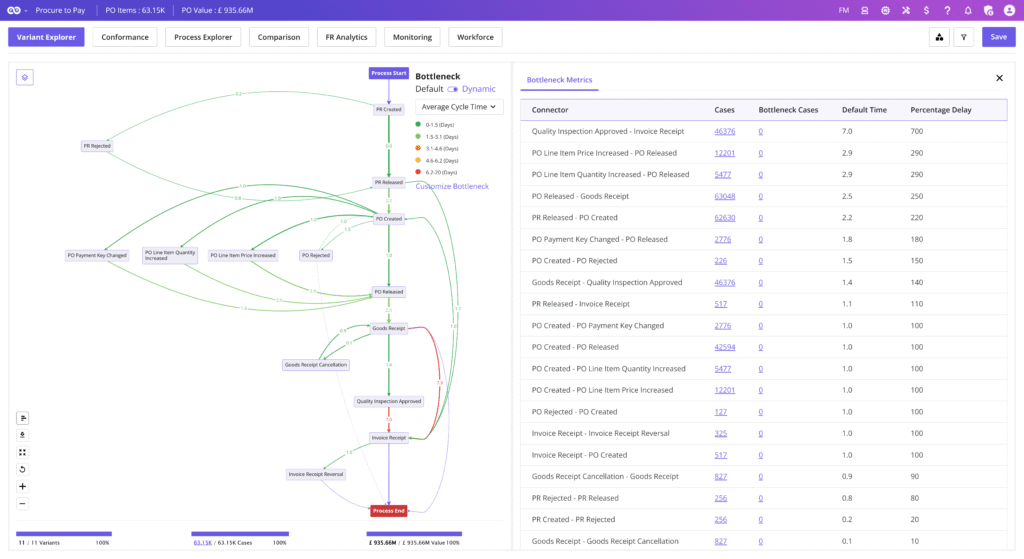
    FUTUROOT mapped the full end-to-end process, revealing bottlenecks like manual approvals and duplicated data entry, quantifying a 40% reduction in cross-region execution differences, and providing a clear list of fix-first priorities before AI implementation.

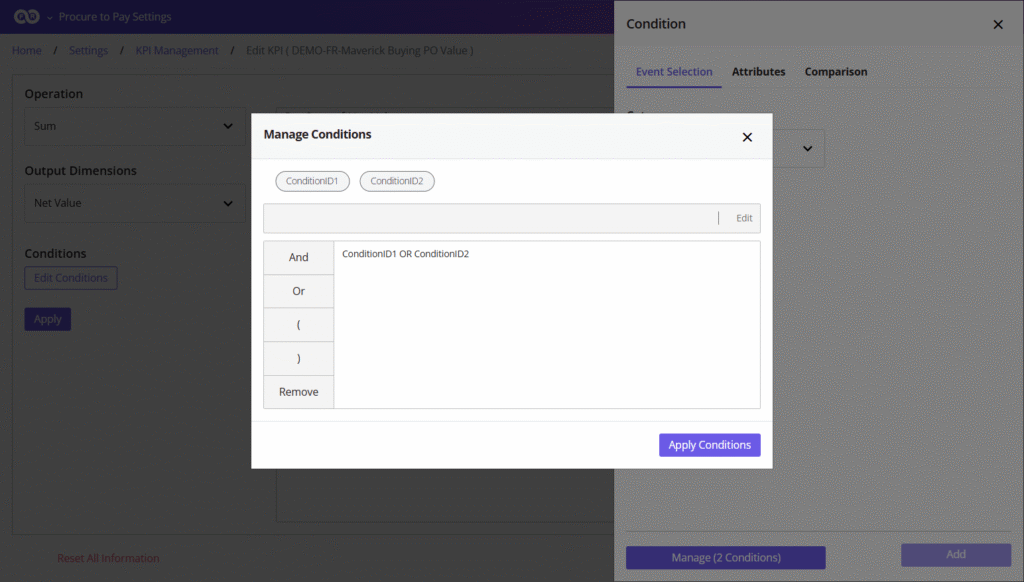
    KPI Management
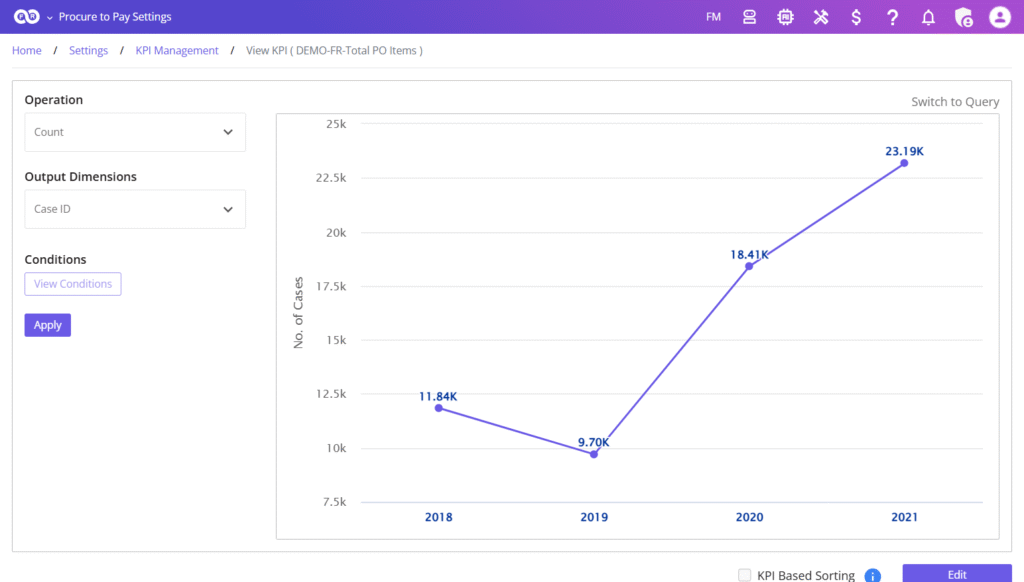
    FUTUROOT was used to define and monitor key performance indicators essential for successful automation, including invoice processing cycle times, touchless invoice rates, and error rates. This included improvements in vendor master accuracy (82% → 96%), conformance to standard process paths (68% → 88%), and reduction of AP exception rates (22% → 10%). This established a baseline allowing leadership to measure improvement with evidence, rather than opinion. 

    FR Anaytics
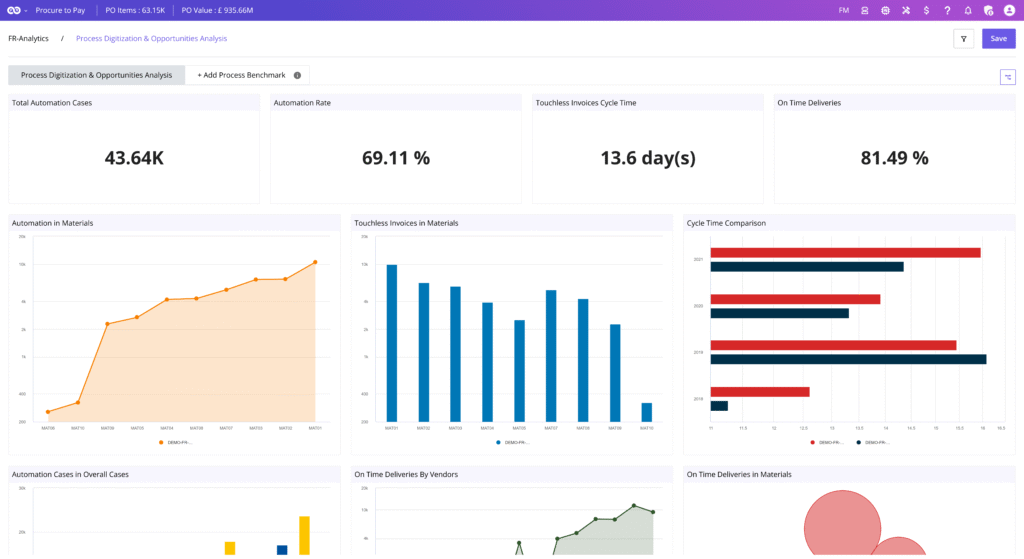
    FUTUROOT analyzed the client’s P2P process and data to generate a comprehensive Automation Readiness Score. This quantitative metric provided a clear, objective benchmark that leadership could use to assess the viability of their AI plans and communicate progress. 

    Business Case Management
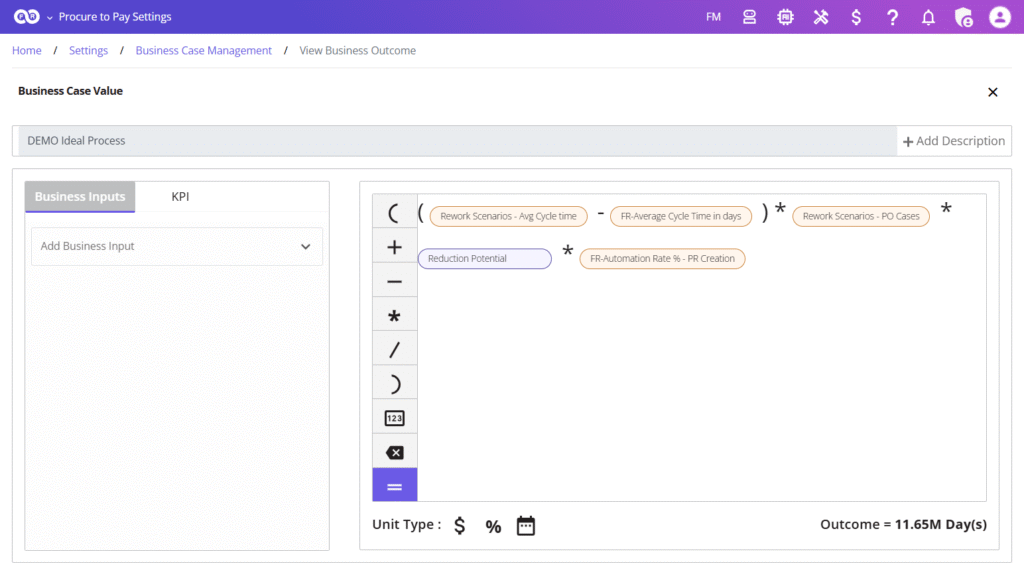
    Findings were integrated into a comprehensive roadmap. FUTUROOT helped the client identify and prioritize the most impactful automation opportunities, quantifying the potential time and cost savings. This included identifying that 35% of AP tasks were automation-ready, representing up to 9,000 hours in annual savings. The result was a sequenced, fact-based AI strategy, not a leap of faith.

    Business Outcomes Delivered

    FUTUROOT transformed what could have been a fragmented, assumption-driven process into a clear, evidence-backed set of actionable outcomes:

    14%
    Improvement in
    Master Data Quality

    Vendor records reached 96% accuracy, improving overall data reliability.

    20%
    Increase in
    Process Conformance

    Workflow standardisation strengthened, ensuring more consistent operations.

    50%
    Reduction in
    AP Exceptions

    Exception rates dropped from 22% to 10%, reducing manual interventions and errors.

    35%
    Increase in
    Automation Potential

    AP activities flagged for automation unlocked ~9,000 hours of potential annual savings.

    37%
    Increase in
    AI Readiness Score

    The improvement from 62 to 85, boosted leadership confidence in upcoming automation initiatives.

  • Driving ROI with Data-Driven Platform Rationalisation

    Driving ROI with Data-Driven Platform Rationalisation

    About this Project

    • Client: Fortune 500 life sciences leader, serving labs and healthcare in 150+ countries. 
    • Industry: Global Science Services 
    • Focus Area: Digital Product ROI & Rationalisation

    The Challenge

    Our client, a global leader in scientific services, had invested in a diverse portfolio of SaaS platforms for Procurement (P2P), Accounts Payable (AP), Order-to-Cash (O2C), and more. With significant capital and resources committed, leadership faced a critical challenge: how to accurately measure the return on these investments. 

    Leadership faced critical questions: 

    • Which platforms were truly being used as intended? 
    • Were the promised efficiencies and cost savings being realized? 
    • Was there overlap and redundancy in the toolset? 
    • Could the company justify continued spending on every platform—or was it time to rationalize and optimise?  

    A lack of visibility risked continued investment in low-value tools, missed opportunities for cost savings, and a fragmented digital environment. They needed a fact-based approach, moving beyond assumptions to confirm the tangible ROI of each platform.

    Why FUTUROOT?

    Traditional methods—user surveys, manual audits, consultant-driven assessments—were too subjective and incomplete. Our client required objective, system-level insights into digital platform usage and outcomes. 

    FUTUROOT delivered exactly that through a system-agnostic process mining approach, connecting directly to event logs across all SaaS platforms. This enabled them to:

    • Track actual usage of each digital tool 
    • Conduct quantifiable ROI analysis 
    • Confirm the real impact of digital investments on P2P, AP, and O2C processes 

    Our Approach: Anchored in Data, Not Assumptions 

    Using FUTUROOT’s advanced toolset, the client gained a transparent understanding of their ERP landscape: 

    Variant Explorer and Process Explorer
    Mapped process variations across SaaS platforms, showing how identical processes like procure-to-pay were executed and providing clear metrics on usage, costs, and adoption.

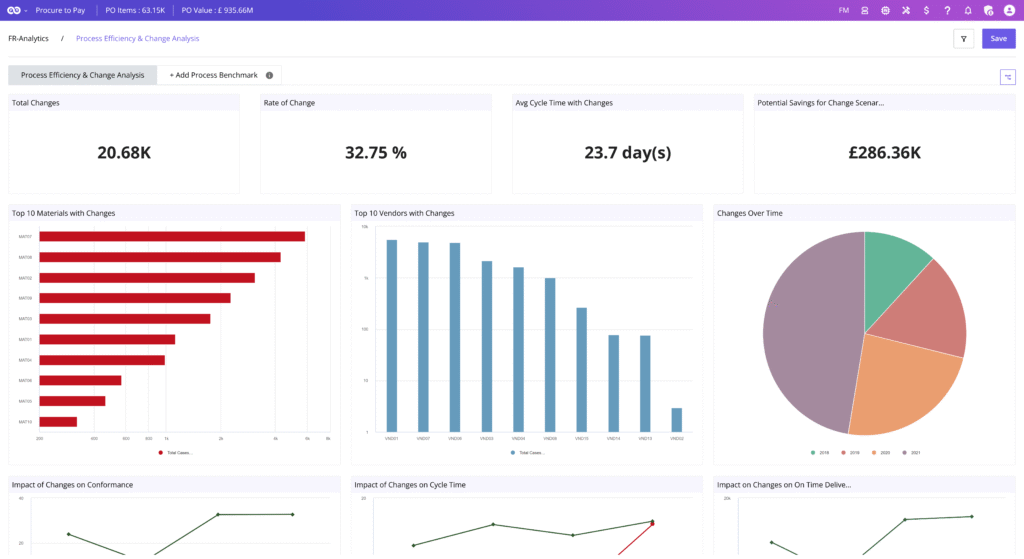
    FR Analytics
    Established measurable success metrics for each platform. Created KPI-based ROI dashboards to quantify both current performance and improvement potential. 

    Business Case Management
    Assessed ROI across all platforms. Flagged underutilized tools for rationalization. Outlined a roadmap for optimising the digital portfolio and retiring low-value systems.   

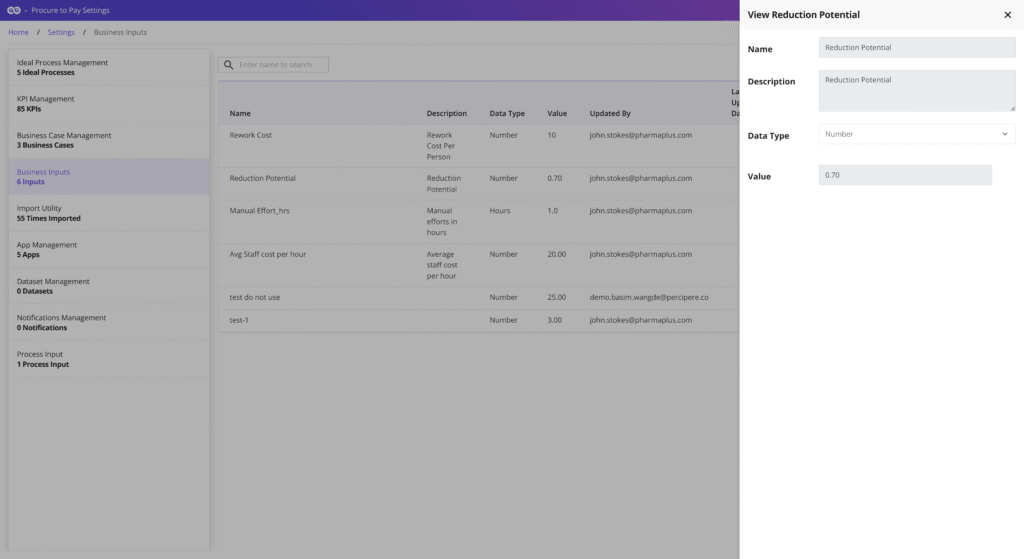
    Business Inputs
    Integrated SaaS licensing and cost data. Directly correlated usage with financial investment. Created a transparent link between adoption and expenditure.

    Business Outcomes Delivered

    FUTUROOT transformed what could have been a fragmented, assumption-driven process into a clear, evidence-backed set of actionable outcomes:

    58%
    Active Usage and Transparent ROI Insights

    Leaders gained clear visibility into platform performance, revealing that only 58% of OCR features were used and highlighting low-value modules for removal.

    $1.2M
    Annual Savings and
    Optimized Digital Investments

    Redundant systems were consolidated, saving $1.2M annually by retiring non-essential CRM add-ons and duplicate tools.

    82%
    Adoption Rate and
    Stronger System Utilization

    Adoption of critical platforms rose sharply, while procurement automation increased to 70% of POs processed straight-through.

    50%
    Faster Cycles and
    Operational Efficiency Gains

    Invoice processing time halved from 14 to 7 days, and OCR errors dropped by 40%, saving 2,500 manual hours each year.

    1.8x
    ROI Uplift and
    Improved Platform Performance

    Clear ROI tracking enabled better investment focus — the OCR platform achieved 2.5x ROI, driving overall digital ROI up by 1.8x.

  • Driving Fact-Based SAP S/4HANA Optimisation

    Driving Fact-Based SAP S/4HANA Optimisation

    About this Project

    • Client: A top 10 global generics and specialty medicines producer, operating in more than 100 countries and supplying markets across the U.S., Europe, and emerging economies.
    • Industry: Pharmaceuticals 
    • Focus Area: SAP S/4HANA Healthcheck Across Procure-to-Pay (P2P), Accounts Payable (AP), and Order-to-Cash (O2C) 

    The Challenge

    A global pharmaceutical company, operating in 100+ countries had been running on SAP S/4HANA for four years. With a new CIO in place, leadership wanted to re-assess whether the company was truly maximizing its ERP investment. 

    The team needed facts, not opinions. The questions emerging were: 

    • Are core processes like P2P, AP and O2C, aligned with SAP best practices? 
    • Which features of SAP S/4HANA are sitting idle? 
    • Where are bottlenecks and risks slowing us down? 
    • And what’s the real ROI on the investment so far? 

    Traditional review methods like workshops and static audits couldn’t answer those questions with confidence. Our client required a fact-based, system-driven health check that could replace subjective debate with data-driven evidence. 

    Why FUTUROOT?

    FUTUROOT applied process mining directly to the client’s SAP S/4HANA event logs, creating an end-to-end, transparent view of how processes ran — step by step, variant by variant. 
    This approach empowered our client to: 

    • Check real adoption against SAP Scope Items and industry standards. Not just “what should happen,” but “what actually happens.” 
    • Spot gaps & Drill into root causes– inefficiencies, unused features, and policy deviations – that erode value 
    • Build a business case with quantified impact. Benchmark performance against industry and SAP standards to measure true process health and quantify improvement opportunities in terms of time, cost, and control impact. 

    In short, FUTUROOT replaced assumption with evidence, eliminating debate and enabling decisive action. 

    Our Approach:

    Using FUTUROOT’s advanced process Analytics Suite, we executed a structured SAP health check in four focus areas:

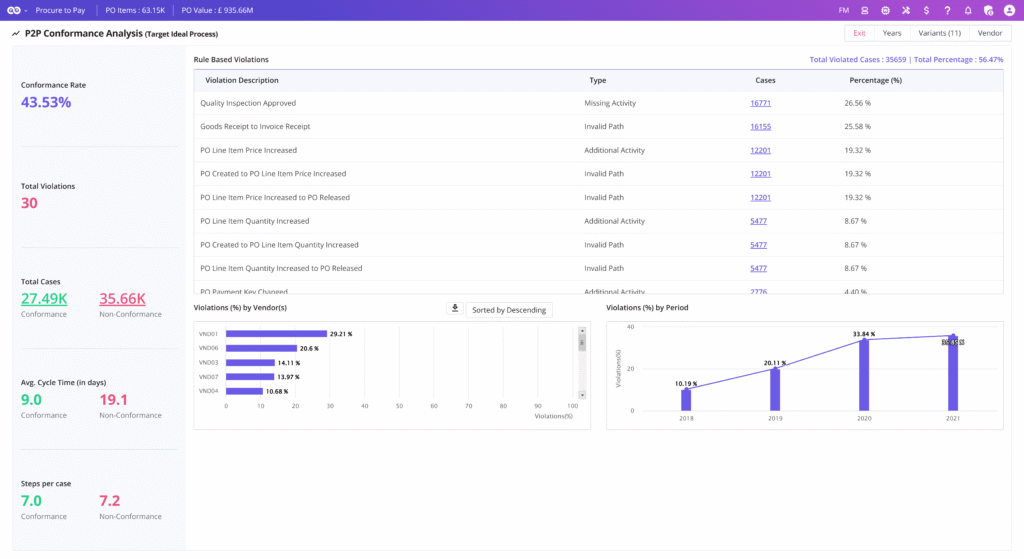
    Conformance Checking

    Lupin’s P2P, AP, and O2C processes were mapped against SAP Scope Items and BPMN “ideal” processes to provide a clear view of operations. The analysis revealed deviations like missing steps, redundant hand-offs, manual workarounds, and policy breaches. By establishing a defensible baseline of “what should happen versus what actually happens,” leadership could prioritize fixes and implement targeted, precise process improvements.

    Root Cause Analysis

    Exceptions and deviations were analysed across vendors, customers, plants, document types, approval chains, and posting behaviors. This uncovered specific causes of delays, rework, and inefficiency, including vendor combinations, master-data issues, and complex approval processes. The insights were then translated into actionable improvements, such as configuration changes, master-data cleanup, training, and governance enhancements.

    KPI Management

    KPIs reflecting best practice adoption—such as touchless transaction rates, cycle times, rework, and exception handling—were defined to measure performance. The analysis provided clear visibility into where best practices were followed and where inefficient or non-standard variants prevailed. This enabled quantification of gaps, setting of measurable targets, and continuous monitoring of improvements.

    Business Case Management

    Identified gaps and KPI deviations were translated into projected time, cost, and control benefits. This revealed tangible opportunities from underutilised features, tighter controls, and streamlined configurations. The insights enabled a prioritised optimisation roadmap with quantified ROI, supporting both technology and business objectives.

    Business Outcomes Delivered

    The SAP S/4HANA health check with FUTUROOT delivered clear, tangible business benefits: 

    25%
    Reduction in Projected ERP Migration Effort

    This equated to an estimated £500K program cost saving.

    25%
    Cross-System Process Mismatches Identified

    Which were all able to then be resolved before blueprinting.

    65%
    Finance and Procurement Workflows Mapped

    As common across ERP systems, driving faster harmonisation.

    25%
    Reduction in
    Order-to-Case Deviations

    The reduction was achieve through standardised workflow design.

  • Driving Fact-Based ERP Harmonisation After a Major Acquisition

    Driving Fact-Based ERP Harmonisation After a Major Acquisition

    About this Project

    • Client: A global manufacturer of power solutions, 
integrating systems after a major acquisition. 

    • Industry: Power Solutions

    • Focus Area: ERP Consolidation During Acquisition

    The Challenge

    A global leader in power solutions, faced a significant integration challenge following its acquisition of a UK-based manufacturing subsidiary

    Leadership needed clarity on key questions: 

    • Are local teams executing HQ’s standardised process, or are deviations common? 
    • Which countries demonstrate higher efficiency, and what are they doing differently? 
    • Where do compliance risks, inefficiencies, and bottlenecks remain hidden? 
    • How can best practices be identified, validated, and scaled company-wide? 

    Without a data-driven, objective view into these processes, our client risked inefficiency, inconsistent compliance, and missed opportunities for collaboration across borders. 

    Why FUTUROOT?

    Traditional consulting methods for ERP harmonization — workshops, interviews, and assumption-driven modelling — were too slow and subjective. The client required fact-based, system-level insights directly from their systems 
to make a confident decision.

    FUTUROOT delivered exactly that — a system-agnostic process mining approach, using real event logs from both Oracle NetSuite and SAP. This enabled them to: 

    • Processes that had quietly drifted far from SAP best pract
    • Approval layers and manual steps that dragged down cycle times. 
    • Redundancies that added cost without adding value. 

    For the first time, the team had a shared fact base. Debates stopped revolving around opinions and started focusing on evidence. That shift in perspective became the anchor for their migration strategy — pragmatic, data-driven, and built on truth. 

    Our Approach:

    Using FUTUROOT’s advanced toolset, the client gained a transparent understanding of their ERP landscape: 

    Variant Explorer
    All process variations across both ERP systems were mapped, revealing differences in how identical processes—like P2P were executed between the US (Oracle) and the UK (SAP). This enabled clear comparison and filtering by system, geography, and business unit.

    Process Comparison
    We conducted a side-by-side comparison of Oracle and SAP process flows, highlighting key differences such as approval hierarchies, invoice-processing steps, and cycle times.

    KPI Management
    We established measurable success metrics for consolidation—such as invoice processing times, order-to-cash cycle efficiency, automation levels, and error rates—and quantified both current inefficiencies and future improvement potential.

    Conformance Checking
    We benchmarked both ERPs against defined target rules, flagging missing activities, duplicated handoffs, and redundant workflows in real time, while also identifying valuable practices from SAP that should be preserved post-merger.

    Business Case Management
    We integrated the findings into a comprehensive roadmap that outlined harmonisation scenarios, quantified cost savings, and defined ROI, delivering a fact-based recommendation backed by data rather than opinion.

    Business Outcomes Delivered

    FUTUROOT transformed what could have been a prolonged, high-risk guesswork 
exercise into a rapid, evidence-backed strategic decision:  

    25%
    Reduction in Projected ERP Migration Effort

    This equated to an estimated £500K program cost saving. 

    25%
    Cross-System Process Mismatches Identified

    Which were all able to then be resolved before blueprinting.

    65%
    Finance and Procurement Workflows Mapped

    As common across ERP systems, driving faster harmonization. 

    25%
    Reduction in
    Order-to-Case Deviations

    The reduction was achieve through standardised workflow design

  • Standardising Global Operations with Data-Driven Process Intelligence

    Standardising Global Operations with Data-Driven Process Intelligence

    About this Project

    • Client: A global top-10 brewer from Turkey, spanning Europe, Central Asia, and the Middle East
    • Industry: Beverages (Multinational FMCG) 
    • Focus Area: Global Process Benchmarking & Standardization Across Countries (P2P, AP, O2C) 

    The Challenge: Inconsistent Ways of Working Across Borders 

    As a leading beverage group with operations in multiple countries faced a challenge common to global enterprises: inconsistency and lack of transparency between headquarters (HQ) and local operations. Each country had developed its own approach to Procure-to-Pay (P2P), Accounts Payable (AP), and Order-to-Cash (O2C). 

    Leadership needed clarity on key questions: 

    • Are local teams executing HQ’s standardised process, or are deviations common? 
    • Which countries demonstrate higher efficiency, and what are they doing differently? 
    • Where do compliance risks, inefficiencies, and bottlenecks remain hidden? 
    • How can best practices be identified, validated, and scaled company-wide? 

    Without a data-driven, objective view into these processes, our client risked inefficiency, inconsistent compliance, and missed opportunities for collaboration across borders. 

    Why FUTUROOT?

    Earlier attempts at benchmarking relied on anecdotal input and static reports, which lacked rigour and depth. The client required a platform that could: 

    Leadership needed clarity on key questions: 

    • Connect directly to operational data across all territories and systems. 
    • Provide real-time, quantitative comparisons of process performance by geography. 
    • Benchmark each country’s execution objectively against HQ’s “golden standard.” 
    • Surface best practices and deviations instantly to guide improvement. 

    FUTUROOT offered process mining and analytics tools purpose-built for this challenge, enabling a rigorous, scalable, and transparent approach to global process harmonisation.  

    Our Approach:

    Using FUTUROOT’ we did:

    Dimension-Based Benchmarking
    By connecting to data sources across all countries, FUTUROOT mapped end-to-end P2P, AP, and O2C processes per market, providing clear comparisons of cycle times, throughput, automation rates, and process variants. Global dashboards offered instant scorecards of efficiency and standardisation, allowing teams to focus improvement where it mattered most. As a result, PO creation cycle times dropped from 9.2 days to 5.8, as markets adopted proven best practices and harmonised their ways of working.

    Conformance Checking
    FUTUROOT’s visual overlays and KPI comparisons highlighted top-performing geographies and surfaced local innovations worth scaling such as streamlined approval flows and higher automation rates. Side-by-side process views enabled knowledge transfer and rapid rollout of the most effective variants across the network.   

    Standardised KPI Management
    A single global dashboard was introduced to define, monitor, and track KPIs—creating one language of performance and replacing subjective reporting with hard data. Core metrics included Average P2P Cycle Time, Touchless Invoice Rate, and On-Time Delivery %. This unified view drove immediate impact: invoice processing deviations fell from 30% to 12% across subsidiaries, reinforcing global consistency and accountability..   


    Best Practice Identification
    Headquarters’ ideal process model was loaded into the platform to run automated checks against real-world execution. Deviations were flagged instantly, producing conformance scores and violation metrics for each country. This data replaced anecdotal debate with factual compliance measurement—raising process conformance from 78% to 92% in Poland and from 85% to 95% in Turkey after standardisation.   

    Cross-country Standardisation Index
    By closing performance gaps between subsidiaries, variance in OTC order-fulfilment lead times fell by 40%—delivering a more consistent and predictable customer experience across markets. 

    Workforce Analytics
    Resource utilisation was analysed to expose workload imbalances, bottlenecks, and opportunities for targeted training or redeployment. Automation readiness assessments revealed that 30% of AP transactions could be automated, unlocking projected annual savings of €1.2 million and freeing teams for higher-value work.  

    Business Outcomes Delivered

    FUTUROOT transformed a fragmented, inconsistent global operation into a unified, evidence-based performance improvement journey — driving measurable efficiency, compliance, and collaboration across regions.

    20%
    Higher Global Process Conformance 

    Standardized operations improved alignment with global best practices, strengthening overall process reliability.

    35%
    Faster Cycles and
    Reduced PO Lead Times

    Cycle times for PO creation and approval shortened significantly, improving procurement efficiency across regions.

    18%
    Fewer Exceptions and
    Improved Invoice Accuracy

    Fewer invoice discrepancies reduced rework and enhanced compliance within the Accounts Payable process.

    40%
    Variance Reduction
    and Consistent O2C Fulfilment

    Variance in O2C lead times across subsidiaries dropped sharply, enabling consistent global service levels.

  • Fact-Based Inventory Process Discovery

    Fact-Based Inventory Process Discovery

    About this Project

    • Client: Global enterprise in Food & Beverage Distribution
    • Industry: Food & Beverage Distribution
    • Focus Area: SAP Vistex Implementation – Inventory Management

    The Challenge

    The client, a leading European food service distributor, embarked on a critical project to implement SAP Vistex. However, the company faced a significant hurdle: its existing inventory management system was over 20 years old. Due to its age and extensive use, no one in the organization had a complete, accurate understanding of all the real-world inventory scenarios that had developed over time

    Decades of accumulated complexity created serious questions for leadership: 

    • How could they ensure a smooth and controlled transformation without full visibility into their current processes?
    • What were the actual process flows and variations in inventory movement?
    • Which of the numerous inventory movement types were truly active, and which were obsolete legacy configurations?
    • How did these hidden processes impact forecasting models and business operations? 

    A lack of factual insights could lead to unnecessary customization, wasted testing, and major disruptions during the SAP Vistex rollout. Leadership needed objectivity, clarity, and factual insights — not assumptions or guesswork.

    Why FUTUROOT?

    The client faced a 20-year-old, complex inventory system with limited visibility, making a controlled SAP Vistex transformation risky. FUTUROOT delivered clarity, speed, and confidence by: 

    FUTUROOT delivered clarity, speed, and confidence by:

    • Uncovering Hidden Processes — Revealed all active and inactive inventory movement types.
    • Quantifying Variants — Mapped 87 scenarios versus 12 known, enabling harmonization.
    • Reducing Risk and Waste — Highlighted redundant processes and unnecessary testing.
    • Providing a Fact-Based Roadmap — Delivered dashboards and actionable metrics for data-driven decisions.

    This approach transformed what could have been a lengthy, high-risk inventory transformation into a rapid, evidence-backed, and controlled process.

    Our Approach: 

    Using FUTUROOT’s advanced toolset, the client gained a transparent understanding of their inventory management landscape:

    Process Explorer

    Analysed 98% of all inventory transactions, distinguishing active from inactive movement types. This eliminated obsolete processes, reducing unnecessary customisation, testing effort, and risk.

    Variant Explorer

    The analysis identified 87 inventory variants versus 12 previously known, enabling harmonization, cutting 45% of redundancies, and providing full visibility into all processes.

    KPI Analysis

    Addressing bottlenecks cut exception rates from 22% to 9% and reduced stock reconciliation cycle times by 30%. Process frequency was quantified and linked to forecasting, enabling data-driven updates.

    FUTUROOT Analytics 

    FUTUROOT integrated findings into interactive dashboards, presenting process variations, movement types, and key KPIs in a clear, executive-friendly view.

    Additional Impact

    Retiring 15% of inactive material codes improved data cleanliness, while reducing test case volume by 35% saved six weeks of UAT effort.

    Business Outcomes Delivered

    FUTUROOT transformed what could have been a prolonged, high-risk guesswork 
exercise into a rapid, evidence-backed strategic decision:  

    87%
    Inventory Scenarios Mapped

    All active and inactive inventory scenarios were identified, providing a complete, fact-based blueprint for transformation..

    45%
    Redundant Process Reduction

    Harmonisation eliminated nearly half of unnecessary process variants, reducing complexity and risk.

    30%
    Faster Cycle Times

    Stock reconciliation and inventory processes were streamlined cutting cycle times from 10 to 7 days.

    35%
    Reduced Test Case Volume

    UAT effort was reduced by over a third, saving six weeks of testing and accelerating the rollout..

  • Driving Fact-Based Accounts Payable Automation

    Driving Fact-Based Accounts Payable Automation

    About this Project

    • Client: Global leader in specialty insurance distribution and niche risk solutions
    • Industry: Insurance & Specialty Services 
    • Focus Area: Automation Roadmap Across Accounts Payable (AP)

    The Challenge

    Our Client, a global specialty insurance firm, faced a significant challenge in its Accounts Payable process. The company operated with multiple AP company codes and a high volume of manual activities across territories, all running on SAP. 

    Leadership knew inefficiencies existed—but they lacked the objective data to pinpoint which specific, rule-based tasks were ripe for automation, and where the potential impact was greatest. They faced critical questions:

    • Which repetitive tasks were most suitable for automation across territories? 
    • What was the quantifiable potential for efficiency gains, cost savings, and error reduction? 
    • How could they build a clear, prioritised automation roadmap across different business units? 

    Without system-based evidence, automation risked becoming another costly, assumption-driven initiative. 

    Why FUTUROOT?

    The client needed more than high-level assumptions — they required data-driven clarity to identify automation opportunities and quantify impact.

    FUTUROOT delivered by:

    • Revealing Automation Hotspots — Identified repetitive, rule-based AP tasks across company codes and territories that were ripe for automation.
    • Quantifying Resource Savings — Measured manual effort and error-prone steps to prioritize initiatives with the highest ROI.
    • Exposing Process Bottlenecks — Highlighted delays and handoffs in AP workflows that slowed invoice processing and increased risk.
    • Providing a Fact-Based Business Case — Quantified potential improvements in cycle times, error reduction, and cost savings to guide investment decisions.

    This approach transformed the initiative from a speculative, assumption-driven effort into a clear, evidence-backed automation strategy, giving leadership confidence that resources would be invested where the greatest impact could be achieved.

    Our Approach: Anchored in Data, Not Assumptions 

    Using FUTUROOT’s advanced automation readiness toolkit, our client gained a transparent, multi-level view of their AP landscape: 

    Variant Explorer
    Cross-Code & Territory Analysis – Analysed process variations across company codes and geographies. This revealed how identical tasks (e.g., invoice processing) were executed differently and pinpointed where repetitive, rule-based tasks were most prevalent. Leadership could filter and compare data by territory or unit, ensuring automation opportunities were scalable, not siloed. 

    Workforce Analytics
    Manual Effort Hotspots – Mapped where human time and effort were consumed most heavily. This provided a clear picture of the “automation sweet spots”—the steps where automation would free up the most resources and reduce error-prone manual work.  

    FR Analytics & Business Case Calculators
    Quantified ROI – Established measurable success metrics (processing times, error rates, cycle efficiency). Quantified both current inefficiencies and future improvement potential, giving leadership a robust, fact-based business case to guide investment.   


    Bottleneck Analysis
    Cycle Acceleration – Visualised where delays occurred in the AP workflow, exposing handoffs and process steps that created cycle-time drag. These became prime targets for automation to accelerate end-to-end processing.

    Business Outcomes Delivered

    FUTUROOT transformed what could have been a prolonged, high-risk guesswork 
exercise into a rapid, evidence-backed strategic decision:  

    42%
    Automation-Ready Invoices

    Process mining revealed 42% of AP postings were ready for automation, doubling straight-through processing from 35% to 70%.

    2.5K
    Hours of
    Reduced Manual Workload

    Automation of repetitive invoice checks eliminated low-value tasks, freeing teams to focus on strategic activities.

    45%
    Error and Exception Reduction

    AP error rates dropped by 45%, eliminating thousands of correction tickets and reducing rework.

    50%
    Faster Invoice Cycles

    Processing time was cut from 12 days to 6 days, accelerating end-to-end AP workflows.

    $1M
    Cost Savings from Automation

    Automation delivered $1.5M in annual savings by reducing manual workload and improving process efficiency.